Compare # Clean Agent Fk 5 1 12 Explained Passive Fire Patch Editorial Team 2026-08-07 ## yaml title: “Clean Agent FK-5-1-12 (Novec 1230) Explained: Chemistry, Safety, and Applications” date: 2026-08-07
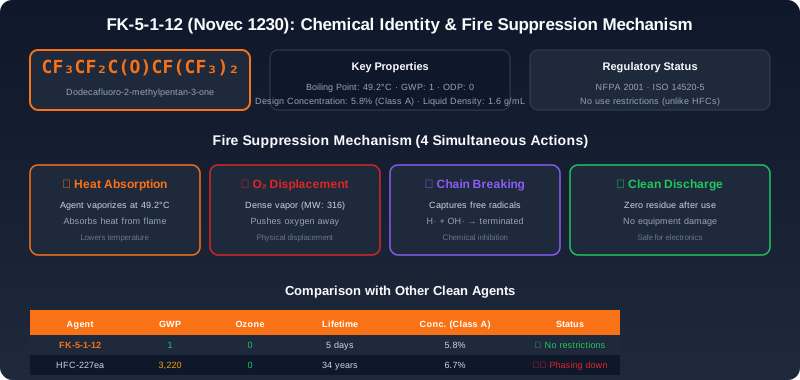
Figure 1: FK-5-1-12 chemical identity and four simultaneous fire suppression mechanisms — heat absorption, oxygen displacement, radical chain breaking, and clean discharge — compared to HFC alternatives.
Fluorinated ketone FK-5-1-12 has become one of the most consequential chemicals in modern fire protection engineering. Originally commercialized by 3M under the trade designation Novec 1230, the molecule has reshaped expectations for what a gaseous fire-suppression agent can deliver: high extinguishing performance, low toxicity, negligible environmental impact, and compatibility with electronics. As patent restrictions have eased, the agent has moved beyond traditional cylinder-based total-flooding systems into compact, point-of-origin delivery formats that extend clean-agent protection to applications previously considered uneconomic.
This article provides a vendor-neutral, technically detailed examination of FK-5-1-12. It is intended for fire-protection engineers, facility managers, AHJs (authorities having jurisdiction), risk assessors, and anyone responsible for specifying or maintaining clean-agent suppression systems.
What Is FK-5-1-12?
FK-5-1-12 is the ASHRAE designation for dodecafluoro-2-methylpentan-3-one, a fully fluorinated ketone with the molecular formula C₆F₁₂O. At ambient conditions it is a clear, colorless, electrically non-conductive liquid with a faint, slightly sweet odor. Its boiling point of approximately 49 °C (120 °F) is unusually low for a fire-suppression fluid; when discharged near a flame, the liquid flash-vaporizes almost instantaneously, dispersing as a gas that mixes readily with the surrounding air.
The compound was developed in the late 1990s and commercialized in the early 2000s as a direct response to the phase-out of Halon 1301 (bromotrifluoromethane) under the Montreal Protocol of 1987. Halon had been the reference clean agent for aviation, military, telecommunications, and data-center protection for decades, but its bromine content gave it an ozone depletion potential (ODP) of approximately 10, leading to a global production ban for fire-protection use. The search for a drop-in successor that retained Halon’s desirable physical behavior while eliminating its environmental burden drove a wave of fluorinated chemistries — and FK-5-1-12 emerged as the most balanced candidate.
Chemical and Physical Properties
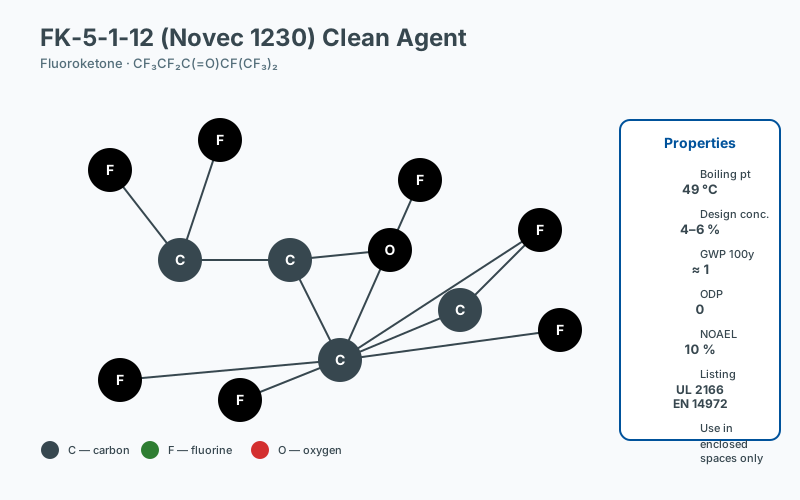 FK-5-1-12 molecule and properties
A summary of the principal physical properties of FK-5-1-12, drawn from manufacturer technical data sheets and ECHA REACH registration dossiers, is provided below.
| Property | Value |
|---|---|
| Chemical formula | C₆F₁₂O (dodecafluoro-2-methylpentan-3-one) |
| Molecular weight | 316.04 g/mol |
| Boiling point (1 atm) | 49.2 °C (120.6 °F) |
| Freezing point | −108 °C (−162 °F) |
| Liquid density (25 °C) | 1.60 g/mL |
| Vapor pressure (25 °C) | 40.4 kPa |
| Heat of vaporization | 88.1 kJ/kg |
| Dielectric strength | ≈ 110 kV at 0.1 in gap (approaching SF₆ range) |
| Electrical conductivity | Non-conductive when vaporized |
| Fire point | None — non-flammable |
Several of these values merit emphasis. The high liquid density (about 1.6 times that of water) means a small volume of fluid produces a large mass of vapor. The very low freezing point allows storage and operation across virtually any terrestrial climate without freeze-protection measures. The combination of high vapor pressure and moderate boiling point produces the rapid vaporization that is central to the agent’s fire-suppression performance.
How FK-5-1-12 Extinguishes Fire
FK-5-1-12 suppresses combustion through two mechanisms operating in parallel. Both are well documented in fire-science literature and recognized in design standards such as NFPA 2001.
Heat Absorption (Physical Mechanism — Dominant)
Approximately 80% of the extinguishing effect arises from physical cooling. When the stored liquid is discharged, whether from a pressurized cylinder through a nozzle or by thermal activation of a microencapsulated patch, it vaporizes. The latent heat of vaporization of 88.1 kJ/kg represents the thermal energy removed from the combustion zone. While this is small compared with water’s 2,260 kJ/kg, the comparison is misleading: water must be delivered as droplets that contact the fuel, and only the surface fraction of those droplets absorbs heat before reaching the ground. FK-5-1-12 vaporizes as it leaves the storage device, dispersing uniformly throughout the protected volume and removing heat from the flame envelope itself, the hot gas layer, and the surrounding air.
Chemical Interference (Chemical Mechanism — Secondary)
The remaining ~20% of extinguishing effect comes from chemical action. Combustion in hydrocarbon flames propagates through a branched-chain reaction involving hydrogen (H•), hydroxyl (OH•), and oxygen (O•) radicals. The fluorine-bearing decomposition products of FK-5-1-12 scavenge these radicals, terminating the chain carriers and suppressing flame propagation at the chemical level. This mechanism is similar in principle to the action of Halon 1301, although considerably weaker — an important reason why FK-5-1-12 must be used at a meaningful design concentration rather than at Halon’s very low levels.
Environmental Profile
The environmental behavior of any halocarbon is governed by three parameters: ozone depletion potential (ODP), global warming potential (GWP), and atmospheric lifetime (ALT). FK-5-1-12 is exceptional in all three.
| Metric | FK-5-1-12 | Halon 1301 | HFC-227ea (FM-200) | HFC-23 | CO₂ |
|---|---|---|---|---|---|
| Ozone Depletion Potential | 0 | 10 | 0 | 0 | 0 |
| Global Warming Potential (100-yr) | 1 | — | 3,220 | 14,800 | 1 |
| Atmospheric lifetime | ~5 days | 65 years | 33 years | 270 years | Centuries |
| SNAP status (US EPA) | Acceptable | Banned | Acceptable, restricted | Acceptable, restricted | Acceptable |
The reason for the very short atmospheric lifetime is the strong absorption of FK-5-1-12 in the ultraviolet region. Photolysis in the troposphere — within days of release — cleaves the molecule, producing stable fluorinated fragments (predominantly trifluoroacetic acid, TFA, and related species) that are subsequently removed by wet and dry deposition. The agent therefore does not survive long enough to reach the stratosphere, eliminating any meaningful ozone impact, and contributes negligibly to radiative forcing.
A long-running scientific debate concerns TFA accumulation in surface waters. Because TFA is highly persistent in the aquatic environment (it does not hydrolyze or biodegrade readily), ongoing research by national environmental agencies continues to track its long-term trends. At present, concentrations attributable to FK-5-1-12 use are orders of magnitude below any toxicological threshold of concern, but the issue is regularly reviewed under REACH and EPA programs.
Human Safety and Toxicological Profile
The safety of any gaseous suppression agent in occupied spaces depends on the relationship between its design concentration (the concentration needed to extinguish a fire) and its toxicological limits. The relevant parameters, drawn from manufacturer studies and recognized in NFPA 2001 Annex B, are:
- NOAEL (No Observed Adverse Effect Level): 10.0% v/v in a 4-hour acute inhalation study in rats.
- LOAEL (Lowest Observed Adverse Effect Level): greater than 10.0% — the limit of testing, no adverse effects observed.
- Cardiac No Observed Effect Level (for epinephrine sensitization): 10.0% — the agent does not sensitize the heart to catecholamine-induced arrhythmia at or below this concentration, a critical property given the cardiac sensitization hazard associated with some halocarbons.
- Design concentration (Class A and Class B hazards): typically 4.0% to 6.0% by volume, depending on fuel and enclosure geometry.
The wide margin between design concentration (≈5%) and NOAEL (10%) provides a safety factor of approximately 2: a doubling of agent concentration would still be required to reach the lowest level at which any effect has been observed in animal studies. This margin is fundamental to FK-5-1-12’s acceptance in normally occupied enclosures under NFPA 2001 and equivalent international standards.
Note that all halocarbon agents at sufficient concentration can produce asphyxiation by oxygen displacement, and FK-5-1-12 is no exception. Safe use therefore requires discharge alarms, pre-discharge delays (typically 30 seconds), personnel evacuation procedures, and adequate enclosure ventilation after discharge. These are mandatory design elements, not optional features.
Comparison with Other Clean Agents
Selecting a clean agent involves balancing environmental impact, extinguishing performance, toxicity margin, storage volume, and lifecycle cost. The table below summarizes the principal alternatives.
| Agent | GWP | Atmospheric Life | Design Conc. | Approx. Cost/kg |
|---|---|---|---|---|
| FK-5-1-12 | 1 | ~5 days | 4–6% | $80–120 |
| HFC-227ea (FM-200) | 3,220 | 33 years | 7–9% | $40–60 |
| HFC-125 (FE-25) | 3,500 | 29 years | 8–10% | $30–50 |
| IG-541 (Inergen) | 0 | N/A | 35–40% | $5–10 |
| HFC-23 (FE-13) | 14,800 | 270 years | 12–15% | $60–80 |
Inert-gas blends such as IG-541 have zero GWP and excellent environmental credentials, but their design concentration is more than seven times that of FK-5-1-12. This requires very large cylinder banks and significant storage footprint, often making them uneconomic for smaller enclosures or distributed equipment protection. Hydrofluorocarbons such as HFC-227ea and HFC-125 are technically effective and lower in first cost, but their high GWP and long atmospheric lifetimes have made them targets of the Kigali Amendment to the Montreal Protocol, with mandatory phase-down schedules under EPA regulations (40 CFR Part 82) and the EU F-Gas Regulation (Regulation (EU) 517/2014, as amended). FK-5-1-12 is not classified as a hydrofluorocarbon, is not controlled under the Kigali Amendment phase-down, and is expected to retain unrestricted availability for the foreseeable future.
Regulatory Status
FK-5-1-12 is widely accepted by major regulatory regimes and listing agencies:
- United States EPA: Listed as acceptable under the Significant New Alternatives Policy (SNAP) program for total flooding and local application.
- European Union: Registered under REACH; not subject to F-Gas phase-down.
- NFPA: Recognized in NFPA 2001 (Standard on Clean Agent Fire Extinguishing Systems) for both total flooding and local application, and referenced in NFPA 75 (Information Technology Equipment).
- UL: Listed components and systems recognized under UL 2166 (Halocarbon Clean Agent Extinguishing System Units).
- FM Global: Approved per FM Approval Standard 5580 (Clean Agent Extinguishing Systems).
- ISO: Covered within the ISO 14520 series of standards for gaseous fire-extinguishing systems.
Standards and Engineering References
Designers should consult the following documents when engineering an FK-5-1-12 system:
- NFPA 2001 — Design, installation, and maintenance of clean-agent systems, including concentration calculation methods (cup-burner derived, supplemented by Class B minimums) and the ISO 14520 calculation methodology.
- ISO 14520-1 and ISO 14520-5 — International equivalents for gaseous extinguishing systems, with detailed guidance on the multiple of the extinguishing concentration and safety factors.
- EN 15004 — European standard for gaseous fire-extinguishing systems (physical agents).
- UL 2166 / FM 5580 — Component listing standards.
- CGA G-6.5 — Standard for small stationary insulated carbon dioxide and halocarbon carbon dioxide supply containers, applicable to the storage pressure vessels.
Application Domains
FK-5-1-12 is used in a wide variety of protection scenarios, including:
- Data centers and server rooms (NFPA 75, NFPA 76).
- Telecommunications central offices and remote cabinets.
- Electrical substations, switchgear rooms, and UPS enclosures.
- Control rooms, archives, and museum storage facilities.
- Medical imaging suites (MRI control rooms, where the agent must be non-magnetic and non-conductive).
- Marine engine rooms and offshore equipment enclosures (subject to IMO and class society requirements).
- Distributed point-of-origin applications: industrial control cabinets, EV battery enclosures, lithium-ion battery storage racks, consumer electronics, and similar equipment enclosures.
The last category is the most significant recent development. Traditional total-flooding systems use cylinders charged with tens to hundreds of kilograms of agent and require fixed piping, nozzles, detection, and control panels. The newer generation of microencapsulated, thermally activated patches stores grams of agent in a sealed polymer film; when the ambient temperature exceeds a designed threshold (typically 180–200 °C), the capsule ruptures and releases the agent directly into the enclosure where the fire originated. This approach eliminates detection, piping, and power requirements and makes clean-agent suppression practical at cost points that total-flooding systems cannot reach.
Future Outlook
The original patent on FK-5-1-12 expired in the early 2020s, and the molecule is now produced by several fluorochemical manufacturers worldwide. This has consequences for the entire clean-agent market:
- Cost reductions as supply competition increases.
- Wider adoption in price-sensitive applications such as consumer electronics, EV battery protection, and small commercial equipment.
- Innovation in delivery formats, particularly microencapsulation and thermally triggered patches, which reduce the per-application cost of protection by one to two orders of magnitude compared with traditional cylinder systems.
The combination of strong environmental performance, proven safety in occupied spaces, regulatory stability, and the emergence of low-cost point-of-origin delivery devices makes FK-5-1-12 the most likely long-term dominant clean agent for the foreseeable horizon — and a foundational chemistry for the next generation of fire-protection engineering.
Frequently Asked Questions
How do I evaluate which technology fits my specific hazard?
Start with a structured risk assessment: identify the fire load, credible ignition sources, and propagation pathways. Then match the suppression technology's tested performance to that hazard profile (enclosure volume, fire growth class, agent compatibility, and installation environment). Standards-based engineering judgment, supported by manufacturer data and third-party listings, is more reliable than generic comparison tables.
Are there hybrid systems that combine multiple suppression approaches?
Yes. Hybrid designs that combine passive point-of-origin suppression with active detection-and-flooding, or that combine a gaseous system with a pre-engineered aerosol, are used in higher-hazard enclosures. The key is to verify that the combined systems do not interfere with one another and that the design as a whole meets the relevant standard for the application.
Can two different suppression technologies be used in the same enclosure?
In principle, yes, if both are designed for the same protected volume and the combined agent concentrations remain within the safety limits for the enclosure. In practice, interaction effects between agents are not always well characterized, and most manufacturers recommend a single primary technology per enclosure. Engineering analysis and AHJ acceptance are required for hybrid designs.
What is the most overlooked factor in suppression technology selection?
Compatibility of the suppression agent with the equipment being protected: electrical compatibility for energized systems, residue tolerance for clean-electronics environments, and pressure-rise tolerance for sealed enclosures. Many selection decisions focus on agent volume and ignore these compatibility questions until after an incident.