Clean Agent vs. Dry Powder Fire Suppression for Electronics
 Fire classes — clean agent vs dry powder
A fire that begins inside an electrical cabinet, server rack, telecommunications shelter, or control panel is rarely the largest threat to the equipment inside it. Once the suppression agent discharges, the secondary consequences — chemical residues, corrosion, conductive contamination, downtime, and component replacement — frequently exceed the cost of the original incident. Choosing the wrong agent can mean trading fire damage for chemical damage, and in many electronic environments the two are equally destructive.
This guide provides a vendor-neutral, engineering-focused comparison of clean agent and dry powder suppression for electronics-rich environments. It examines the chemistry, residue behavior, applicable standards, performance against each fire class, environmental profile, total cost of ownership, and deployment formats available to facility managers, electrical engineers, and IT infrastructure designers.
How the Two Agents Actually Work
Dry Chemical Powder (ABC Powder)
The familiar red-canned extinguisher found in almost every commercial and industrial facility uses dry chemical powder, almost always monoammonium phosphate (NH₄H₂PO₄) for ABC-rated products. ABC powder extinguishes fire through two simultaneous mechanisms:
- Thermal smothering and crusting — when the powder contacts hot or burning surfaces, monoammonium phosphate melts at approximately 190 °C and forms a glassy, adherent crust. This crust excludes oxygen from the fuel surface and continues to block re-ignition even after the cloud has settled.
- Chemical chain-breaking inhibition — the vapor phase of the agent, together with fine particulates in the flame zone, interferes with the free-radical propagation reactions (H•, O•, OH•) that sustain combustion. This is the dominant extinguishing mechanism in the flame itself.
The chemistry is effective, but the byproducts are mechanically and electrochemically aggressive. Once discharged, dry powder coats every internal surface it can reach.
Clean Agents: FK-5-1-12 and the Modern Halocarbon Family
Modern “clean” agents for occupied and electronics-dense spaces are fluorinated ketones, hydrofluorocarbons, or inert gas blends. The most widely deployed in fixed systems today is FK-5-1-12 (chemical name dodecafluoro-2-methylpentan-3-one), commercialized under the trade name Novec 1230, with alternatives such as HFC-227ea (FM-200) and inert gas blends (IG-541, IG-100, IG-01) specified for similar applications.
Clean agents extinguish fire almost entirely through physical mechanisms:
- Heat absorption (latent cooling) — rapid vaporization of the liquid agent absorbs large quantities of thermal energy from the flame zone. For FK-5-1-12 this accounts for roughly 80 percent of extinguishing effectiveness.
- Chemical interference — fluorinated species generated in the flame disrupt radical chain reactions, accounting for the remaining ~20 percent.
Because the agent vaporizes at room conditions and leaves no residue, nothing remains on the protected equipment after discharge. This single property changes the economics of fire protection for electronics.
The Residue Problem
The defining divergence between the two technologies is post-discharge residue. For an electrical cabinet, this is where the engineering decision is really made.
| Factor | Dry Powder | Clean Agent |
|---|---|---|
| Visible residue | Heavy, adherent powder cloud | None — fully vaporizes |
| Corrosivity to copper, tin, silver | High — forms conductive and ionic residues that continue to corrode | None |
| Effect on PCBs, backplanes, fiber optics | Coats and etches; often requires board-level rework | No effect |
| Cleanup effort | Manual scrubbing, vacuuming, IPA wash, often factory-return for boards | Ventilate, restart |
| Downtime after discharge | Hours to days; equipment frequently unrecoverable | Minutes |
| Long-term latent damage | Creep corrosion can fail equipment weeks later | None |
Real-World Consequence
The 2010s and 2020s produced a steady stream of post-incident reports from data centers and telecom sites documenting the same pattern: a small incipient fire suppressed with a dry powder extinguisher, followed by the loss of equipment that never directly caught fire. A representative European telecom incident in 2023 involved an open server rack in which a powder extinguisher was discharged; the originating PSU fire was contained, but all four servers were written off due to powder contamination across motherboards and high-speed backplanes, at a replacement cost of approximately €32,000.
In a clean-agent-protected enclosure, the same fire would have resulted in an agent discharge, a brief ventilation cycle, and the replacement of the failed PSU only.
Fire-Class Performance Comparison
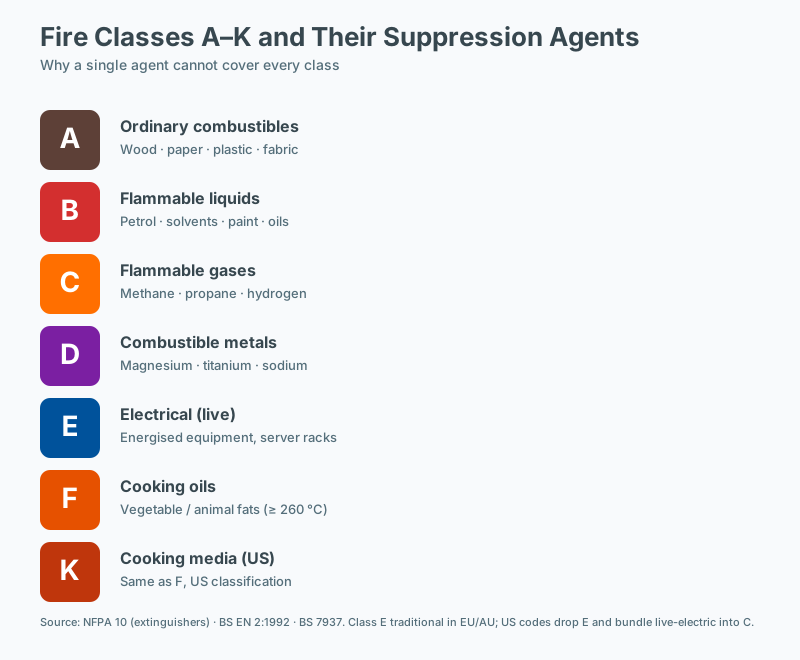
Suppression agents are formally classified against standardized fire classes defined in ISO 3941, NFPA 10, and EN 2. The relevant classes for electronic environments are A, B, C, and increasingly D (because of lithium-ion battery risk).
| Fire Class | Description | Dry Powder | Clean Agent |
|---|---|---|---|
| A | Solid combustibles — cable insulation, PCB laminate, plastics | Excellent | Good |
| B | Flammable liquids — capacitor electrolyte, hydraulic fluid, cleaning solvents | Excellent | Good |
| C | Energized electrical — short circuits, arcing, overloaded busbars | Good (per UL 711 / EN 3-7) | Good (per NFPA 2001, ISO 14520) |
| D | Combustible metals — lithium, magnesium, sodium | Specifically rated (graphite/copper Class D agents only) | Limited and design-specific (typically for lithium-ion battery fires, not pure metal fires) |
For the bulk of electronic hazards — energized faults, overheated insulation, electrolytic capacitor venting — both technologies will reliably extinguish the fire. The discriminator is what happens after.
Applicable Standards
A technically defensible suppression specification references recognized consensus standards rather than marketing brochures.
- NFPA 10 — Standard for Portable Fire Extinguishers (covers dry chemical handheld units).
- NFPA 2001 — Standard on Clean Agent Fire Extinguishing Systems (FK-5-1-12, HFC-227ea, inert gases).
- ISO 14520 — Gaseous media fire-extinguishing systems for the international community.
- EN 3-7 — Portable fire extinguishers (European performance and testing).
- UL 711 — Rating and fire testing of fire extinguishers.
- UL 9540 / UL 9540A — Energy storage systems, including battery enclosure fire propagation testing.
- NFPA 855 — Installation of stationary energy storage systems.
- IEC 62676 and EN 50173 — Relevant where suppression interacts with telecommunications cabling infrastructure.
- ASTM D6062 — Sampling and analysis of FK-5-1-12 for purity verification.
- NFPA 75 — Standard for the Protection of Information Technology Equipment (often the governing standard for data centers specifying clean agent systems).
- ANSI/UL 60692 — Electrically non-conducting extinguishing media, important when verifying that an agent will not short energized equipment.
For any new system in a regulated environment, specifying agent and hardware to one of these standards — and documenting it in the commissioning package — is the baseline expectation of an Authority Having Jurisdiction (AHJ).
Environmental and Safety Profile
| Factor | Dry Powder | Clean Agent (FK-5-1-12) |
|---|---|---|
| Ozone Depletion Potential (ODP) | 0 | 0 |
| Global Warming Potential (GWP, 100-yr) | 0 | ~1 (effectively negligible; compares to ~2,900–3,500 for HFC-227ea) |
| Atmospheric lifetime | N/A | ~5 days (orders of magnitude shorter than legacy HFCs) |
| Visibility during discharge | Near-zero — opaque red-brown cloud | Clear |
| Inhalation toxicity | Respiratory irritant; cannot be used in occupied spaces at full discharge concentration | Low toxicity; approved for occupied spaces at design concentration per NFPA 2001 / ISO 14520 with documented safety factor |
| Post-disposal handling | Contaminated powder classified as hazardous waste in many jurisdictions | None — agent fully off-gases; no cleanup stream |
| SNAP / regulatory status | Generally unrestricted | Approved under U.S. EPA SNAP program; increasingly required in jurisdictions restricting high-GWP HFCs |
The transition away from HFC-227ea (FM-200) toward FK-5-1-12 and inert gas blends is being driven by F-Gas Regulation (EU) 517/2014 and parallel restrictions in North America. For new designs in 2026 and beyond, FK-5-1-12 is the default specification in most jurisdictions for occupied electronic spaces.
Total Cost of Ownership
Per-kilogram agent cost is one of the more misleading metrics in fire protection. The relevant comparison is cost per protected enclosure over a realistic service life, including failure consequence.
| Cost Element | Dry Powder | Clean Agent (FK-5-1-12) |
|---|---|---|
| Agent cost per kg | $2–5 | $80–120 |
| Typical quantity per cabinet or rack fire | 2–5 kg | 50–300 g |
| Direct agent cost per fire event | $10–25 | $4–36 |
| Equipment replacement risk per event | High — frequently thousands to tens of thousands of euros/dollars | None — no residue |
| Downtime after event | Hours to days | Minutes |
| True cost per discharge event | $50 to >$50,000 | The agent refill or patch replacement: under $50 in most cases |
Once secondary damage and downtime are included, dry powder’s apparent cost advantage disappears for any installation where the protected equipment is worth more than the powder cost. In practice, this means almost every server rack, telecom shelter, control cabinet, and battery enclosure.
Deployment Form Factors
The two technologies offer very different deployment options, and these options strongly influence real-world reliability.
| Form Factor | Dry Powder | Clean Agent |
|---|---|---|
| Handheld portable extinguisher | Ubiquitous | Available but rare; clean agent extinguishers are heavy and expensive |
| Fixed automatic system (heat- or smoke-actuated nozzles) | Tube-based systems exist, less common in pure electronics enclosures | Standard NFPA 2001 / ISO 14520 room flooding; localized systems for cabinets |
| Passive, zero-power device | Not available — dry powder needs a pressurized vessel and actuation | Available as microencapsulated patches that rupture on reaching ~170 °C and release the agent into the enclosure |
| Total flooding of a room | Impractical for occupied rooms | Standard for data centers and similar |
The last row deserves attention. Passive, microencapsulated clean-agent patches are a relatively recent form factor: small flat pouches mounted inside a cabinet that rupture when the surrounding temperature exceeds the melting point of the encapsulating polymer. They require no detection system, no pressurized cylinder, no plumbing, no annual hydrostatic test, and no maintenance inspection beyond visual confirmation. For unmanned or remote cabinets where manual intervention is not guaranteed (think roadside telecom cabinets, wind turbine control cabinets, remote pumping stations), passive technology has become the practical default.
Selection Guidance
There is no universal answer, but the following framework maps technology to environment.
Dry powder is generally appropriate where:
- The protected area contains minimal or rugged electronics, such as a generator room.
- Outdoor or heavily ventilated installations where residue is acceptable.
- Budget-constrained, non-critical applications with high human presence.
- A backup layer to a primary clean-agent system, retained for last-resort manual intervention by trained staff.
Clean agent (FK-5-1-12 or equivalent) is the appropriate choice where:
- IT equipment, network gear, or process control electronics are present.
- The enclosure houses battery energy storage, including lithium-ion BESS cabinets and UPS batteries.
- Downtime per incident has business impact measured in lost revenue or safety risk.
- The site is unmanned or rarely visited (telecom, remote telemetry, IoT edge cabinets).
- Recovery must be achievable without a board-level rework facility.
For mixed environments, the clean agent typically addresses the higher-value, lower-tolerance assets (electrical), while handheld dry powder units remain positioned for general-purpose risk in the same facility.
Frequently Asked Questions
What is the most overlooked factor in suppression technology selection?
Compatibility of the suppression agent with the equipment being protected: electrical compatibility for energized systems, residue tolerance for clean-electronics environments, and pressure-rise tolerance for sealed enclosures. Many selection decisions focus on agent volume and ignore these compatibility questions until after an incident.
How do ambient conditions affect suppression technology choice?
Ambient temperature, humidity, and ventilation all affect the performance of both the fire (ignition likelihood, growth rate) and the suppression system (agent concentration retention, device activation timing). Enclosures in high-temperature or high-humidity environments may need devices with higher activation temperatures and corrosion-resistant construction. Manufacturer data should be reviewed against the actual installation environment.
How do I evaluate which technology fits my specific hazard?
Start with a structured risk assessment: identify the fire load, credible ignition sources, and propagation pathways. Then match the suppression technology's tested performance to that hazard profile (enclosure volume, fire growth class, agent compatibility, and installation environment). Standards-based engineering judgment, supported by manufacturer data and third-party listings, is more reliable than generic comparison tables.
Are there hybrid systems that combine multiple suppression approaches?
Yes. Hybrid designs that combine passive point-of-origin suppression with active detection-and-flooding, or that combine a gaseous system with a pre-engineered aerosol, are used in higher-hazard enclosures. The key is to verify that the combined systems do not interfere with one another and that the design as a whole meets the relevant standard for the application.