Compare # Patch Vs Gas Suppression Passive Fire Patch Editorial Team 2026-08-07 ## yaml title: “Fire Patch vs. Gas Suppression: Which One for Enclosed Equipment?” date: 2026-08-07
When protecting enclosed electrical equipment from fire, two fundamentally different approaches compete for the attention of engineers, facility managers, and risk officers: traditional gaseous suppression systems and the newer class of microencapsulated passive fire patch technology. Both serve the same overarching goal — preventing a fire event from escalating into a catastrophic loss — but they operate on entirely different principles, and the choice between them carries major implications for capital cost, lifecycle maintenance, regulatory compliance, occupant safety, and real-world effectiveness.
This article provides a vendor-neutral, engineering-focused comparison of the two technologies, the standards that govern them, the deployment contexts where each excels, and the increasingly common hybrid architectures that combine the strengths of both.
How They Work
Gas Suppression Systems
Room-level gaseous fire suppression has been the dominant technology for protecting IT rooms, telecommunications hubs, control rooms, and archives since the 1990s. Clean agents such as FM-200 (HFC-227ea), Novec 1230 (FK-5-1-12), Inergen (IG-541), and argon-based blends flood an entire room or large enclosure with a fire-suppressing gas at a concentration designed to interrupt the combustion chemistry or the flame-propagation chain reaction.
The activation sequence is fully engineered and follows the requirements of NFPA 2001 (Standard on Clean Agent Fire Extinguishing Systems) and, outside North America, ISO 14520 or the EN 15004 series. In a typical sequence:
- A smoke detection system — usually aspirating smoke detection (ASD) per EN 54-20 Classes A, B, or C, or point-type optical detection — senses combustion products.
- The fire alarm control panel (FACP) processes the signal and verifies the alarm condition, often with a coincidence or cross-zoned logic to reduce unwanted discharges.
- Audible and visual alarms (strobes, horns, voice evacuation) warn occupants in accordance with NFPA 72 or EN 54-23/54-16.
- The FACP commands the heating, ventilation, and air-conditioning (HVAC) system to shut down and any fire/smoke dampers to close, preserving the agent concentration.
- After a pre-discharge delay (typically 30 seconds) intended to allow personnel evacuation, the agent discharges from pressurized cylinders through a network of piping and discharge nozzles.
- The room reaches its design concentration — typically between 4 % and 10 % by volume, depending on the agent — and must hold that concentration for a minimum soaking period of 10 minutes as required by NFPA 2001.
For personnel safety, the Occupational Safety and Health Administration (OSHA) and equivalent European regulations require that ambient oxygen levels remain above the threshold where asphyxiation risk becomes significant. Inergen and argon blends are designed to maintain oxygen above approximately 12 %, while chemical agents such as FM-200 and Novec 1230 achieve suppression at concentrations well below the no-observable-adverse-effect level (NOAEL) but still require a pre-discharge alarm and evacuation.
Fire Patches
A passive fire patch operates on a fundamentally different principle: it is a thermally activated, self-contained suppression device that mounts directly on or inside the equipment it protects. The most widely deployed variant is based on a microencapsulated agent — a proprietary formulation of fire-suppressing compounds sealed within tiny polymer shells that rupture at a defined activation temperature.
The activation sequence is deliberately simple:
- A fire starts inside an electrical enclosure (server rack, switchboard cabinet, battery cabinet, inverter housing, control panel).
- Internal air temperature at the patch location rises and reaches the activation threshold, typically around 170 °C, well below the auto-ignition temperature of common cable insulation (PVC: ~350 °C; XLPE: ~320 °C).
- The microcapsules rupture and the agent rapidly vaporizes into the local atmosphere.
- The released agent reaches effective fire-suppressing concentration within the immediate enclosure volume within 3–5 seconds.
- The fire is suppressed at its source, before it can propagate to adjacent enclosures, cabling trays, or room-level combustibles.
Because the device is purely passive, it requires no external power, no detection loop, no control panel, and no moving parts. It cannot be disabled by a power outage, a failed sensor, a disconnected cable, or a misconfigured FACP. Once installed, it remains in standby for the entire service life of the host equipment, with replacement typically recommended at 10-year intervals.
Head-to-Head Comparison
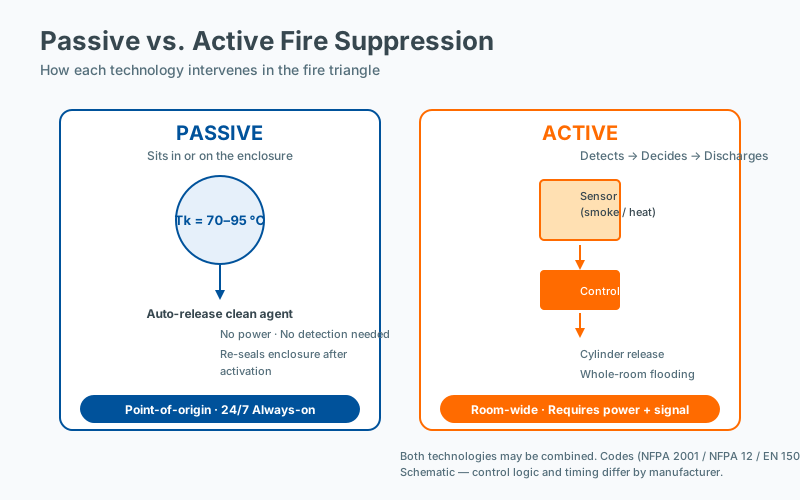 Patch vs gas suppression
The table below summarizes the principal engineering and operational differences between the two approaches. Values are typical for a representative 100-rack data hall; actual figures will vary with room geometry, agent choice, local labor rates, and regulatory environment.
| Factor | Room Gas Suppression | Fire Patches |
|---|---|---|
| Protection scope | Entire room (all equipment simultaneously) | Individual enclosure, point of origin |
| Detection method | Active smoke detection (powered loop) | Passive thermal activation |
| Activation power | Requires electricity, batteries, control panel | None required |
| Installation time | 2–8 weeks (cylinder room, piping, nozzles, detection) | 5–10 minutes per rack (peel-and-stick installation) |
| Installation cost | $50,000–$150,000 per data hall | $50–$200 per enclosure |
| Annual maintenance | $2,000–$5,000 (semiannual inspection, cylinder weighing) | $0 |
| Major service | Hydrostatic testing of cylinders every 5–10 years (DOT, TPED, or EN 1968) | Replace patches every 10 years |
| False discharge cost | $5,000–$15,000 (agent refill, room downtime, investigation) | N/A — heat-activated only |
| Discharge downtime | 4–24 hours (ventilation, reset, refill, leak check) | None — isolated to a single enclosure |
| Collateral effect | All equipment in the protected space exposed to the agent | Only the affected enclosure |
| Environmental impact (GWP) | FM-200: 3,220; HFC-125: 3,500; Novec 1230 (FK-5-1-12): 1; Inergen: 0 | FK-5-1-12-based patches: 1 |
| Standards reference | NFPA 2001, ISO 14520, EN 15004, UL 2166, FM Approval Class 6034 | UL 2775 (microencapsulated units, where certified) |
When Each Technology Makes Sense
Choose Room Gas Suppression When:
- The protected space is a homogeneous environment in which any fire event threatens all equipment simultaneously (for example, a small telecommunications equipment room under 80 m³ where NFPA 2001 makes suppression cost-effective).
- The room itself, rather than individual enclosures, represents the dominant fire risk — for example, a room with extensive combustible cable trays overhead.
- Regulatory or insurance requirements explicitly mandate total-flooding protection. In many European jurisdictions, EN 15004-compliant systems are required for occupied or escape-route-adjacent IT rooms above a threshold floor area or combustible load.
- The facility has a dedicated, trained fire-systems maintenance team capable of performing the required semiannual inspections under NFPA 2001 Annex A or equivalent.
- Capital budget is not the binding constraint and the organization values the redundancy of a code-compliant room-level system.
Choose Fire Patches When:
- The protection target is a discrete, high-value asset — a switchboard, an EV charging cabinet, a battery energy storage system (BESS) enclosure, a remote telecom shelter, an industrial control panel — where local suppression at the point of ignition is the most defensible approach.
- Equipment is installed in remote, unmanned, or intermittently occupied locations where the response time of a room-level system would be inadequate.
- Zero-maintenance protection is required. Many industrial sites, mining operations, and utilities have neither the budget nor the staffing for the ongoing inspection regime of a gaseous system.
- Capital budget is constrained and a phased rollout is required across many enclosures.
- Equipment is being retrofitted into an existing space that was never designed for a piped gas suppression system. Installing cylinders, manifolds, and nozzles into a finished room is expensive and disruptive; peel-and-stick patches can be deployed in minutes.
- The design intent is defense-in-depth: patches act as the first line of defense at the enclosure, with the room gas system as the building-level safety net.
The Combined Approach
Increasingly, the most defensible answer to the gas-vs-patch question is both. A layered or hybrid architecture positions the fire patch as the first responder and the room gas system as the building-level safety net. Several published case studies and insurance-engineering guidance (including FM Global Property Loss Prevention Data Sheet 5-33 and DS 5-26 for lithium-ion storage) recommend or permit such hybrid arrangements where the local suppression reduces the probability of total-flooding discharge.
In this configuration:
- More than 90 % of incipient equipment fires are suppressed by the patch before the room system activates, based on field data from hyperscale data center operators.
- The expensive, code-mandated room system discharges only for fires that escape the equipment of origin — events that, in practice, are rare once patches are deployed.
- Total cost of ownership is often lower than room gas alone, because discharge events are uncommon and refill costs are correspondingly reduced.
10-Year Cost Comparison — 100-Rack Data Hall
| Cost Category | Gas Only | Patches Only | Combined |
|---|---|---|---|
| Installation | $85,000 | $15,000 | $95,000 |
| 10-year maintenance | $35,000 | $0 | $35,000 |
| Patch replacement (year 10) | $0 | $15,000 | $15,000 |
| Estimated discharge events | 1–2 (contained) | 0–1 | 0–1 |
| Discharge costs | $10,000–$30,000 | $0 | $5,000–$15,000 |
| 10-Year Total Cost of Ownership | $130,000–$150,000 | $30,000 | $150,000–$160,000 |
While the combined approach carries the highest nominal capital expenditure, the reduction in discharge frequency often makes it the lowest total-cost option in facilities where room gas discharges have already occurred. It is also the only configuration that fully addresses the dominant failure mode of room gas systems: a false or unnecessary discharge triggered by detector contamination, steam, cooking aerosols, or operator error.
Engineering and Standards Context
Both technologies are subject to a maturing but still uneven standards landscape. NFPA 2001 governs total-flooding clean agent systems in the United States and is widely referenced internationally. ISO 14520 and the EN 15004 series provide parallel or supplementary requirements in Europe and other jurisdictions. Component-level certification is typically achieved through UL Listings (UL 2166 for clean agents, UL 2775 for microencapsulated units) or FM Approvals (FM Approval Class 6034 for gaseous systems).
For fire patches, UL 2775 is the principal North American standard. It defines performance criteria including activation temperature tolerance, suppression effectiveness on representative fire scenarios (Class A, B, and C per NFPA 10), endurance testing, and shelf life. European certification is typically provided through EAC or ETA pathways, and CE marking is increasingly required for installations in EU member states.
End users should also consider the requirements of:
- NFPA 72 — National Fire Alarm and Signaling Code (for detection and annunciation interfaces)
- NFPA 75 — Standard for the Fire Protection of Information Technology Equipment
- NFPA 76 — Standard for the Fire Protection of Telecommunications Facilities
- EN 54 — Fire detection and fire alarm systems (component standards)
- IEC 62619 — Secondary lithium cells and batteries for industrial applications (for BESS applications)
For mission-critical facilities, the Uptime Institute Tier classification and the TIA-942-B telecommunications infrastructure standard may also impose design constraints that influence suppression selection.
Frequently Asked Questions
Are there hybrid systems that combine multiple suppression approaches?
Yes. Hybrid designs that combine passive point-of-origin suppression with active detection-and-flooding, or that combine a gaseous system with a pre-engineered aerosol, are used in higher-hazard enclosures. The key is to verify that the combined systems do not interfere with one another and that the design as a whole meets the relevant standard for the application.
Can two different suppression technologies be used in the same enclosure?
In principle, yes, if both are designed for the same protected volume and the combined agent concentrations remain within the safety limits for the enclosure. In practice, interaction effects between agents are not always well characterized, and most manufacturers recommend a single primary technology per enclosure. Engineering analysis and AHJ acceptance are required for hybrid designs.
What is the most overlooked factor in suppression technology selection?
Compatibility of the suppression agent with the equipment being protected: electrical compatibility for energized systems, residue tolerance for clean-electronics environments, and pressure-rise tolerance for sealed enclosures. Many selection decisions focus on agent volume and ignore these compatibility questions until after an incident.
How do ambient conditions affect suppression technology choice?
Ambient temperature, humidity, and ventilation all affect the performance of both the fire (ignition likelihood, growth rate) and the suppression system (agent concentration retention, device activation timing). Enclosures in high-temperature or high-humidity environments may need devices with higher activation temperatures and corrosion-resistant construction. Manufacturer data should be reviewed against the actual installation environment.