What is a passive fire patch?
A passive fire patch is a self-adhesive suppression device lined with thousands of microcapsules containing a clean suppression agent. It is mounted inside an enclosure and, when a fire's heat reaches its activation temperature, releases the agent directly at the source — automatically, with no power or external trigger.
Does it need electricity or wiring?
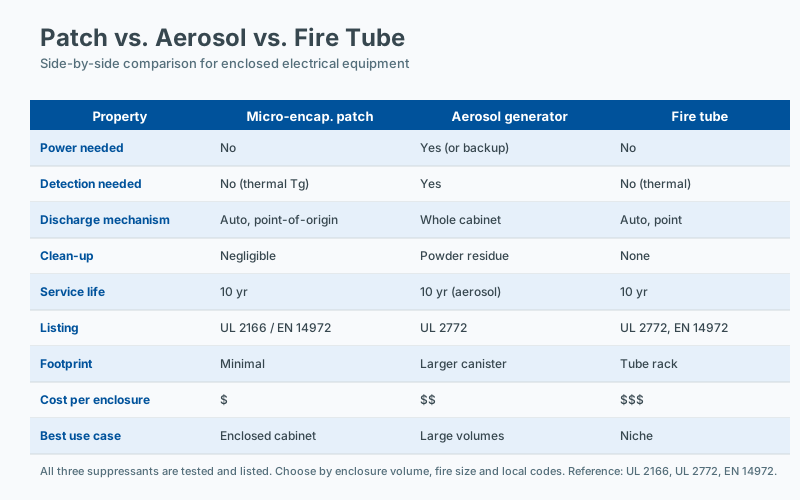 Patch technology comparison
No. The patch is fully passive. It requires no power supply, no detector, no control panel and no piping. Heat from a fire is the only trigger.
How does it activate?
By temperature. The microcapsules are engineered to rupture at a defined activation temperature. When local heat from a fire reaches that point, the capsules release their agent directly into the enclosure.
What kind of fires is it for?
It is designed for the kinds of fires that occur in electrical and light-industrial enclosures — electrical faults and common combustibles in confined spaces. Exact suitability depends on the fire load and enclosure; critical applications should be assessed with the manufacturer or distributor.
Will it damage electronics?
No. The agent is a non-conductive fluoroketone clean agent that leaves no powder, water or residue, so it does not contaminate circuit boards, busbars or contacts the way dry powder or water would.
Does it replace sprinklers or a gas system?
No. It is a complementary, point-of-origin layer. It adds fast, automatic protection inside individual enclosures, while building systems (sprinklers, room gas suppression, detection) protect the wider space. The most effective installations use both.
How long does it last?
Patches are rated for a multi-year service life in normal conditions and require no scheduled maintenance within that period. Actual life varies by model and environment; the rated service life is specified per product and should be recorded at installation.
How do I choose the activation temperature?
Choose a class that sits safely above the highest temperature the patch will experience in normal operation, including hot weather and peak load — but low enough to respond promptly to a real fire. Measuring actual enclosure temperatures under load is the safest approach.
How do I size a patch for an enclosure?
Sizing depends on internal volume, how well the enclosure seals (agent escapes through ventilation), the ambient and activation temperature, and the fire load. Multiple patches may be used to cover several risk points. Your distributor can recommend size and placement from the enclosure dimensions.
Where should it be installed?
Mount it high (heat rises), above likely ignition points such as busbars, terminals, drives and power supplies, and not behind solid obstructions. Avoid locations that reach the activation temperature during normal operation.
Can it be retrofitted to existing panels?
Yes, that is one of its strengths. It is self-adhesive and requires no pipework, wiring or drilling, so it can be installed in existing panels during routine maintenance without a major shutdown.
Is it certified?
Product specifications, availability and approvals vary by market and model. We provide the documentation relevant to your region through your distributor. Where specific local certifications are required, confirm the current status with us before specifying — rather than assuming approval.
What happens after it activates?
The patch releases its agent and is then replaced. Because the agent is clean, there is generally no special cleanup of equipment — the incident is inspected, the cause corrected, and a new patch fitted.
How do I become a distributor?
We work with distributors in the electrical, fire-safety, industrial and IT sectors on a territory basis. Contact us through the partners page to discuss your market, pricing and support.