Introduction
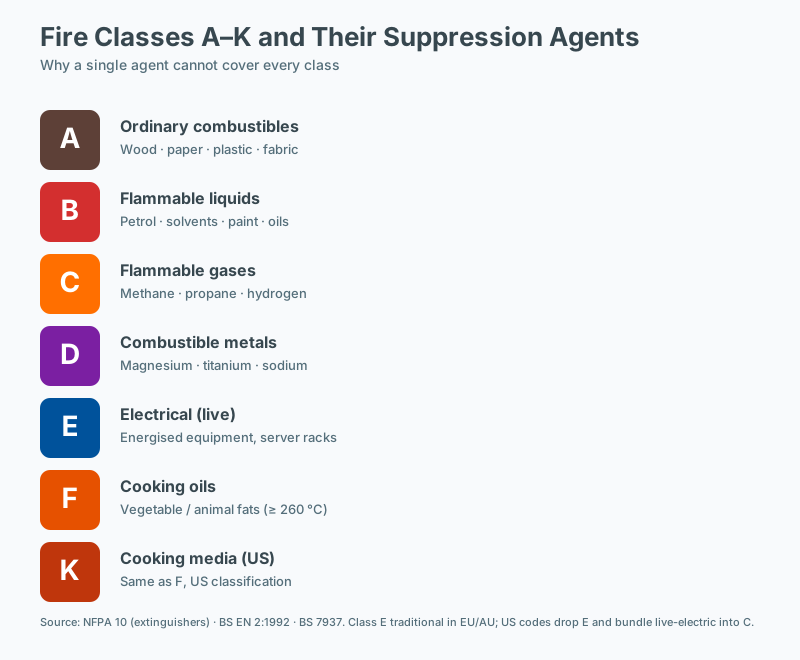 Fire classes A through K
Fires are not a single phenomenon. A flame that consumes a wooden pallet behaves nothing like a short-circuit arc in a control panel, a magnesium flare in a machine shop, or a grease fire in a commercial kitchen. Each of these events involves a different fuel, a different heat release profile, a different combustion chemistry, and—critically—a different suppression strategy. Applying the wrong extinguishing method can be ineffective at best and catastrophically dangerous at worst: a stream of water onto a burning pan of cooking oil can launch flaming liquid across the room, and a water spray onto a sodium fire produces hydrogen gas that detonates with explosive violence.
To bring order to this complexity, fire safety authorities around the world have developed classification systems that group fires by fuel type. The most widely adopted are the North American system (NFPA), the European system (EN 2), and the international standard (ISO 3941). While they share a common conceptual foundation, they label and group the classes differently, which can confuse readers working across documents from multiple jurisdictions.
This article provides a comprehensive, standards-grounded reference to every fire class used in modern practice—from Class A ordinary combustibles through Class K cooking media, with the parallel Class F designation used in Europe and elsewhere. It explains the physical characteristics of each class, the extinguishing mechanisms that suppress it, the compatible and incompatible extinguishing media, and the differences between the major classification systems. A practical extinguisher selection guide for facility managers closes the article, along with a frequently-asked-questions section addressing the most common points of confusion.
Why Fire Classification Matters
Before examining each class individually, it is worth understanding the operational purpose of classification. An extinguisher is not a generic “fire killer”; it is a delivery system for a specific extinguishing agent, optimized for a specific fuel. Standards bodies such as NFPA 10 (Standard for Portable Fire Extinguishers) in the United States and EN 3-7 (Portable fire extinguishers — Part 7: Characteristics, performance requirements and test methods) in Europe exist to ensure that extinguishers are labeled, tested, and rated against the fuels they will actually encounter.
Fire classification accomplishes three goals:
- It links fuel to extinguishing mechanism. Water cools, foam smothers and cools, dry chemical interrupts the chemical chain reaction, carbon dioxide displaces oxygen, and clean agents absorb heat or interfere with combustion kinetics. Each fuel responds to a different combination of these mechanisms.
- It warns against incompatible agents. Some agents are physically or chemically incompatible with certain fuels. Water on burning oil causes a steam-driven eruption; water on energized electrical equipment conducts current; water on reactive metals such as magnesium or sodium produces flammable hydrogen.
- It enables consistent labeling and training. Symbols and letters on extinguishers, placards, and training materials only work because everyone agrees on what a “Class B” or “Class F” fire is.
The Three Major Classification Systems
NFPA (United States and Much of North America)
The National Fire Protection Association system, embedded in NFPA 10, recognizes Classes A, B, C, D, and K:
- Class A — Ordinary combustibles (wood, paper, cloth, rubber, many plastics, trash).
- Class B — Flammable and combustible liquids, flammable gases, greases, and similar petroleum- or solvent-based products.
- Class C — Fires involving energized electrical equipment where the electrical hazard is present.
- Class D — Combustible metals (magnesium, titanium, sodium, lithium, zirconium, and others).
- Class K — Cooking media (vegetable oils, animal fats, cooking greases) in commercial kitchens.
The European system was historically aligned with NFPA, but revisions and local practice have produced differences.
EN 2 (Europe)
The European standard EN 2:1992 + A1:2004 (“Classification of fires”) defines the following classes:
- Class A — Fires involving solid materials, generally of an organic nature, in which combustion normally takes place with the formation of glowing embers.
- Class B — Fires involving liquids or liquefiable solids.
- Class C — Fires involving gases.
- Class D — Fires involving metals.
- Class F — Fires involving cooking media (vegetable or animal oils and fats) in cooking appliances.
A notable difference from NFPA: EN 2 has a dedicated Class C for flammable gases, where NFPA folds gas fires into Class B. European systems also use Class F for cooking fires (not Class K), reflecting the special nature of high-temperature grease fires in commercial kitchens.
ISO 3941 (International)
The ISO 3941:2007 standard (“Fire protection — Fire extinguishing media — Classification”) provides a globally harmonized scheme that closely parallels EN 2. It defines Classes A, B, C, D, and F with definitions very similar to those in EN 2. In practice, ISO 3941 has reinforced the European approach in international training, maritime, and aviation contexts.
A Note on “Class E”
Readers sometimes encounter a “Class E” label for electrical fires, particularly in older European or Australian documentation. Modern European practice does not use a separate electrical class; instead, the standard guidance is that once an energized electrical fire is de-energized (the breaker is opened), it is reclassified as either Class A or Class B depending on the surrounding fuel, and treated accordingly. Some legacy systems and some jurisdictions outside Europe still label electrical fires as Class E.
Class A — Ordinary Combustibles
Physical Characteristics
Class A fires involve solid organic fuels such as wood, paper, cardboard, natural-fiber textiles (cotton, wool, silk), leather, rubber, and many common plastics. The defining combustion characteristic is that these materials decompose (pyrolyze) under heat, releasing combustible gases that then burn in the flame zone above the surface, while a charcoal-like solid matrix continues to burn as glowing embers at and below the surface.
This dual-phase burning is crucial. The flame zone can often be suppressed relatively easily, but if the ember zone retains enough heat, the fire will reignite as soon as the flame is removed. Class A fires therefore require cooling below the ignition temperature of the solid, not merely flame knockdown.
Heat release rates vary widely depending on the material and configuration. A small wastebasket fire may release tens of kilowatts; a fully involved pallet stack can release several megawatts.
Appropriate Extinguishing Methods
- Water is the primary Class A extinguishing agent. Its high heat of vaporization (approximately 2,260 kJ/kg) absorbs enormous quantities of heat as it converts to steam, and the steam itself helps exclude oxygen. Water can be applied as a straight stream (reaching distant fuel), a fog or spray (covering broad surfaces and reducing steam burns to operators), or as a wet chemical foam for deep-seated fuel such as upholstered furniture or bales of fiber.
- Foam (AFFF, AR-AFFF, FFFP) penetrates Class A fuel, clings to vertical surfaces, and provides both cooling and a vapor barrier.
- Dry chemical (ABC powder, monoammonium phosphate-based) works on Class A by coating the fuel surface and forming a chemical barrier that interrupts the flame reaction. ABC powder is a multi-purpose agent and is rated for Class A, B, and C fires.
- Clean agents (halon replacements such as FK-5-1-12, HFC-227ea, or inert gas systems) can suppress Class A surface fires, but are generally not economical for deep-seated Class A fuel.
Inappropriate Methods
Water-miscible liquids and electrical hazards (covered below) preclude water in some cases, but the more important point for Class A is that carbon dioxide alone is generally ineffective on deep-seated Class A fuel. CO₂ displaces oxygen in the immediate vicinity, but because it provides no cooling and the embers remain hot, reignition is likely once the CO₂ disperses.
Class B — Flammable Liquids and Gases
Physical Characteristics
Class B fires involve flammable and combustible liquids (gasoline, diesel, kerosene, acetone, alcohols, solvents), liquefiable solids (paraffin wax, naphthalene), and in NFPA terminology flammable gases (natural gas, propane, hydrogen, methane). The combustion is a vapor-phase reaction; the liquid itself does not burn—its vapors do.
Three sub-categories are commonly distinguished:
- Hydrocarbon liquids (gasoline, heptane, toluene) — float on water and can be extinguished with foams that spread across the liquid surface.
- Polar solvent liquids (alcohols, ketones, esters) — mix with water, so ordinary foams break down; alcohol-resistant (AR) foams are required.
- Liquefied gases (LPG, LNG when spilled) — cryogenic and rapidly vaporizing, presenting unique vapor cloud and BLEVE (boiling liquid expanding vapor explosion) hazards.
Heat release rates for pool fires depend on pool diameter; for a 1-meter gasoline pool, peak heat release rate is roughly 1 MW.
Appropriate Extinguishing Methods
- Foam is the workhorse. AFFF (aqueous film-forming foam) and FFFP (film-forming fluoroprotein) spread rapidly across hydrocarbon surfaces, while AR-AFFF is formulated for polar solvents. Foam works by smothering—forming a vapor-tight blanket that excludes oxygen and suppresses vapor release.
- Dry chemical (ABC or BC powder) knocks down flame rapidly by interrupting the chemical chain reaction in the flame zone. ABC powder (monoammonium phosphate) and BC powder (sodium bicarbonate or potassium bicarbonate) are both effective on Class B.
- Carbon dioxide displaces oxygen and is useful for small incipient Class B fires, especially indoors where residue from dry chemical is undesirable.
- Clean agents and water mist can extinguish Class B fires in enclosed spaces, particularly where electronic equipment or contamination-sensitive materials are nearby.
Special Considerations for Gas Fires
Under NFPA, gas fires are Class B; under EN 2, they are Class C. In all systems, the safest action on a gas fire is usually to shut off the fuel supply rather than fight the flame directly, because an unburned gas cloud can form an explosive atmosphere if the flame is extinguished without stopping the leak. NFPA 12 and NFPA 15 provide additional guidance on gas fire suppression.
Inappropriate Methods
A direct water stream onto a burning hydrocarbon pool will splash the fuel and can spread the fire. Water fog can be useful, but only at low flow rates that avoid splashing. On polar solvents, ordinary foam will be dissolved by the fuel; AR foam is required.
Class C — Energized Electrical Fires
Physical Characteristics
Class C (NFPA) fires involve energized electrical equipment—live wiring, control panels, transformers, motors, server racks, switchgear. The fire itself is not fundamentally different from a Class A or B fire; what is unique is the presence of an electrical hazard that poses shock and arc-flash risk to the operator.
The fuel in a Class C fire depends on the insulating material: PVC cable jackets produce Class A-type solid fuel with corrosive hydrogen chloride smoke; transformer oil produces a Class B liquid fuel; lithium-ion battery fires involve both Class B electrolyte solvents and the metal-cathode chemistry covered under Class D and Class B hybrid scenarios.
Appropriate Extinguishing Methods
- Carbon dioxide — electrically non-conductive, leaves no residue, displaces oxygen.
- Dry chemical (ABC or BC powder) — non-conductive, fast knockdown.
- Clean agents (halocarbon or inert gas) — non-conductive, no residue, ideal for server rooms and control rooms.
- Water mist — when applied through properly designed nozzles, fine water mist can be non-conductive and effective on Class C fires. Bulk water streams, however, are conductive and must not be used on energized equipment above approximately 600 V without specific engineered suppression.
Inappropriate Methods
Bulk water streams are conductive and dangerous. Foam is also conductive and should not be applied to energized equipment. After extinguishment, once the equipment is confirmed de-energized, the fire may be reclassified and re-tackled as Class A or B with appropriate agents.
NFPA vs. EN 2 Again
The most important cross-jurisdictional note: NFPA uses Class C for electrical fires, while EN 2 uses Class C for gas fires. This is a frequent source of confusion. Readers reading European standards and seeing “Class C” should think “gases”; readers reading NFPA standards and seeing “Class C” should think “electrical.”
Class D — Combustible Metals
Physical Characteristics
Class D fires involve reactive metals that burn at extremely high temperatures, often above 2,000 °C, and frequently react violently with water, carbon dioxide, nitrogen, and other common extinguishing agents. Common Class D metals include:
- Magnesium — burns at ~3,100 °C; reacts with water to produce hydrogen.
- Titanium — burns at ~3,000 °C; small shavings can be pyrophoric.
- Sodium and potassium — alkali metals; react violently with water, producing hydrogen and hydroxides.
- Lithium — increasingly common due to batteries; reacts with water.
- Zirconium, hafnium, uranium — found in nuclear and aerospace contexts.
- Aluminum — generally not Class D in bulk form, but aluminum powders and shavings can burn and are treated as Class D.
Class D fires typically produce bright white sparks, intense radiant heat, and in some cases toxic metal-oxide fumes. Magnesium fires in particular are nearly impossible to extinguish with water and were historically attacked with sand or special powders before modern dry powder agents were developed.
Appropriate Extinguishing Methods
- Specially formulated dry powder extinguishing agents are the standard. These are not the same as ABC powder; Class D agents include:
- Sodium chloride (NaCl) powder — for magnesium, sodium, and some aluminum fires.
- Graphite-based powders — for lithium and high-temperature metals.
- Copper powder — for lithium fires.
- Sodium carbonate-based powders — for some alkali metals.
- Dry sand can smother small magnesium or titanium fires by excluding oxygen.
- Specialized noble-gas blanketing is used in some metallurgical contexts.
The dry powder works primarily by smothering and heat absorption, forming a crust that excludes oxygen and conducts heat away from the burning metal.
Inappropriate Methods
Almost everything else is wrong for Class D:
- Water reacts with many reactive metals to produce hydrogen gas, which can detonate. Water must not be applied to magnesium, sodium, potassium, lithium, or aluminum-powder fires.
- Carbon dioxide reacts with some metals (notably magnesium, which can continue to burn in CO₂ by extracting the oxygen).
- ABC dry chemical is not rated for Class D and may be ineffective or produce hazardous reactions.
- Foam contains water and is contraindicated.
Lithium-Ion Battery Fires: A Special Case
Lithium-ion batteries straddle several classes. The electrolyte is a flammable liquid (Class B), the lithium and other cell chemistries can exhibit Class D behavior, and an energized battery is a Class C hazard. Suppression guidance has evolved rapidly; current practice uses water or water mist to cool the cell mass (counterintuitively, since lithium reacts with water, the volume of water dilutes the lithium and the cooling effect dominates for large battery packs), clean agents to extinguish flame, and ultimately immersion or long-duration cooling to prevent thermal runaway reignition. UL 9540A and NFPA 855 provide test methods and installation standards for energy storage systems.
Class K (NFPA) / Class F (EN 2, ISO) — Cooking Media Fires
Physical Characteristics
Class K (NFPA) and Class F (EN 2/ISO 3941) fires involve cooking oils, fats, and greases—both vegetable oils (canola, sunflower, peanut, soybean) and animal fats (lard, tallow). These differ fundamentally from Class B flammable liquids in three ways:
- High flash and autoignition temperatures — cooking oils ignite at 300–400 °C, far above the flash point of gasoline.
- High heat release per unit area — a deep fryer can release heat at a rate that exceeds typical Class B liquid fires of similar footprint.
- Reignition tendency — once the oil is heated above its autoignition temperature, even after flame extinction, the hot oil will reignite spontaneously if oxygen is reintroduced.
This last point is why water on a cooking-oil fire is catastrophic: water is denser than oil, sinks below the oil, instantly vaporizes, and ejects the oil as a 1–2-meter fountain of flaming droplets. The result is a sudden, explosive fire spread.
Appropriate Extinguishing Methods
- Wet chemical extinguishers are the primary suppression medium for Class K/F fires. The agent is typically a potassium acetate, potassium citrate, or potassium carbonate solution, sometimes with corrosion inhibitors. The wet chemical extinguishes by:
- Saponification — reacting with the oil to form a soap-like foam layer on the surface (the “chemical foam” referred to in older standards).
- Cooling — the water content cools the oil below its autoignition temperature.
- Smothering — the soap layer excludes oxygen.
- Class K fire suppression systems for commercial kitchens typically combine a wet chemical agent with automatic nozzles over cooking appliances and a manual activation point near the exit. Standards include NFPA 17A (wet chemical systems) and UL 300 (fire testing of fire suppression for cooking equipment).
- Class B foam is not rated for Class K/F; the foam blanket breaks down rapidly at cooking-oil temperatures.
- Carbon dioxide and dry chemical can knock down a small Class K flame but cannot cool the oil, so reignition is virtually certain. They are not acceptable primary agents in commercial kitchens per NFPA 17A and most jurisdictional fire codes.
Inappropriate Methods
- Water — explosive hazard, must never be used on cooking-oil fires.
- Class B foam — inadequate for high-temperature oils.
- Dry chemical or CO₂ — provides only flame knockdown, not cooling; risk of reignition.
NFPA K vs. EN F
The functions are identical: both designations refer to cooking-oil and cooking-fat fires. The letter differs because the standards bodies chose different labels. NFPA uses K (likely to denote kitchen); EN 2 and ISO 3941 use F (likely to denote frying or *food
Frequently Asked Questions
What determines whether a fire will self-extinguish?
A fire self-extinguishes when the heat losses to the surroundings exceed the heat generated by the combustion. This balance depends on fuel properties, ventilation, and enclosure geometry. In a well-ventilated enclosure with limited fuel, a small fire may self-extinguish; in a confined enclosure with an abundant fire load, the same fire will grow. This is why enclosure sealing and fuel loading are central to suppression design.
What is the relationship between ventilation and fire growth rate?
Ventilation controls the rate at which oxygen is supplied to the fire, which in turn controls the heat-release rate. In a fuel-controlled fire, additional ventilation increases heat release; in a ventilation-controlled fire, additional ventilation has limited effect. Understanding which regime applies to a given enclosure is essential to sizing both detection and suppression.
Why do different materials burn at different temperatures?
The ignition and combustion temperatures of a material depend on its chemical composition, physical form, and thermal properties. Flammable liquids typically ignite at lower temperatures than solid combustibles because their vapors mix with air more readily. These differences are captured in fire-class classifications (A, B, C, D, K) and in the suppression agents appropriate to each class.
How do oxygen concentration and fuel type interact in enclosed fires?
Fire requires fuel, oxygen, and an ignition source in proportions that allow sustained combustion. Reducing oxygen concentration below the limiting oxygen concentration (LOC) for the specific fuel extinguishes the fire. Clean-agent systems are designed to reduce oxygen concentration or to interrupt the radical-chain reactions of the flame, depending on the agent.