Standards # NFPA 855 Compliance Guide for Energy Storage Fire Safety Passive Fire Patch Editorial Team 2026-08-07 # NFPA 855 Compliance Guide for Energy Storage Fire Safety
Introduction
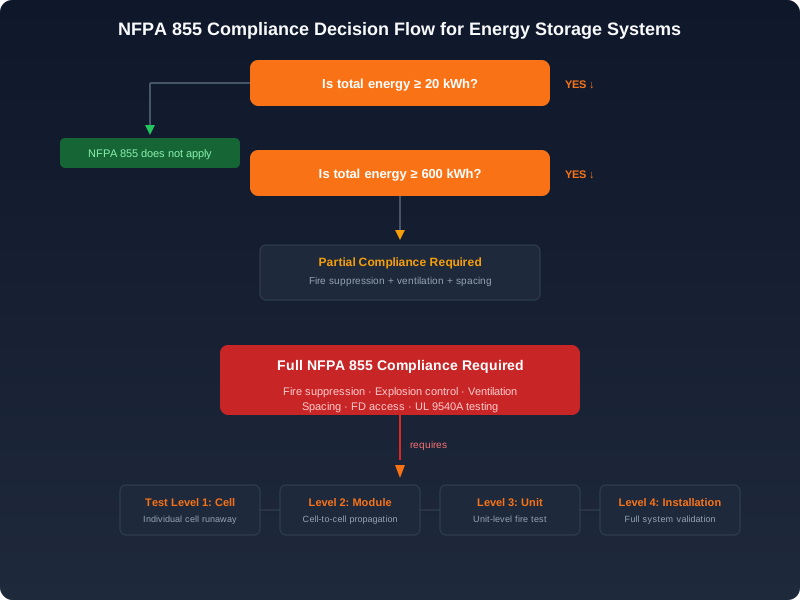
Figure 1: NFPA 855 compliance decision flow for energy storage system installations. Systems above 600 kWh require full compliance including UL 9540A testing at all four levels.
The accelerating deployment of battery energy storage systems (BESS) across residential, commercial, and utility-scale applications has created an urgent need for clear, consistent fire safety guidance. Stationary storage systems—particularly those based on lithium-ion chemistries—introduce hazards that are fundamentally different from those associated with conventional electrical equipment. Thermal runaway, flammable electrolyte venting, and the potential for explosive gas accumulation require a regulatory framework that addresses the unique failure modes of electrochemical storage.
NFPA 855, Standard for the Installation of Stationary Energy Storage Systems, first published in 2019 and substantially revised in subsequent editions (most recently the 2026 edition referenced throughout this guide), is the principal U.S. document governing the safe installation of stationary energy storage. It is referenced by the International Fire Code (IFC), adopted in whole or part by the majority of U.S. jurisdictions, and is increasingly cited by Authorities Having Jurisdiction (AHJs) worldwide as the baseline for BESS fire safety.
This guide provides engineers, facility operators, code consultants, and AHJs with a technically grounded overview of NFPA 855’s scope, threshold-driven applicability, core safety requirements, and a practical compliance roadmap. Where other standards are interrelated—most notably UL 9540 (product safety) and UL 9540A (fire propagation testing)—the linkages are explained explicitly.
1. Scope and Purpose of NFPA 855
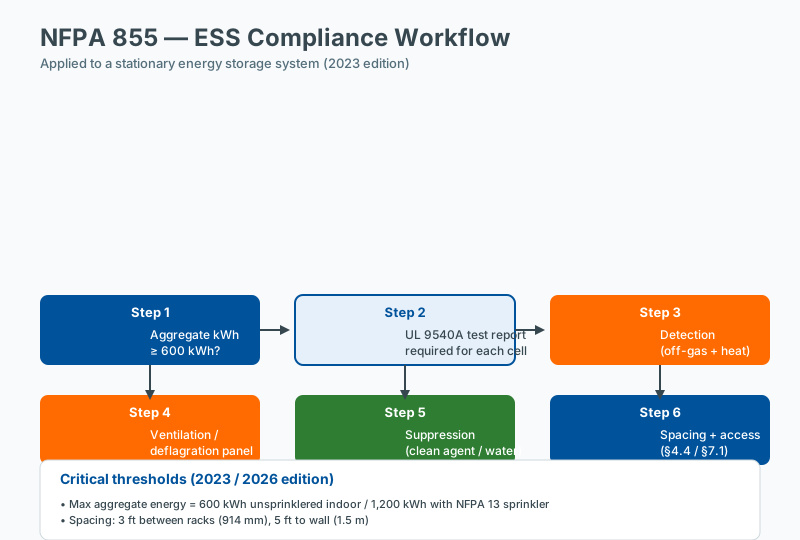 NFPA 855 ESS compliance workflow
1.1 What the Standard Covers
NFPA 855 governs the design, installation, commissioning, operation, maintenance, and decommissioning of stationary energy storage systems. Its scope includes:
- Battery technologies of all chemistries (lithium-ion, lead-acid, flow, sodium-based, etc.), with lithium-ion receiving the most prescriptive treatment due to documented field incidents.
- Capacitor energy storage systems.
- Mechanical storage where interfaced with electrical equipment (e.g., flywheel installations).
- Associated power conversion equipment, thermal management, controls, and ventilation systems.
The standard does not govern portable or mobile storage (e.g., electric vehicle propulsion batteries), nor does it directly cover transportation of new or spent batteries—those fall under U.S. Department of Transportation (DOT) regulations.
1.2 Relationship to Other Codes and Standards
NFPA 855 is a performance- and prescriptive-based installation standard. It is designed to integrate with, not replace, the broader regulatory ecosystem:
Standard / CodeRelationship to NFPA 855**IFC / IRC (2024 and later)**Adopts NFPA 855 thresholds by reference; defines permitting and inspection triggers.**NFPA 1 (Fire Code)**Incorporates NFPA 855 into the broader life safety framework.UL 9540Product listing standard referenced by NFPA 855 as the baseline for equipment acceptance.UL 9540ATest method used to demonstrate compliance with NFPA 855 fire propagation limits.**NFPA 70 (NEC)**Articles 706 (Energy Storage Systems) and 480 (Batteries) govern electrical installation.IEEE 1547 / 2030Interconnection standards often required by utilities.**ICC/NFPA 5000 (Building Codes)**Address structural, egress, and construction classification elements.
A compliant BESS installation is one that satisfies all applicable layers—NFPA 855 alone is necessary but not sufficient.
2. Threshold-Based Applicability
NFPA 855 introduces a tiered applicability structure that scales prescriptive requirements according to the aggregate nameplate energy capacity of the storage system. The threshold logic reflects a risk gradient: larger systems pose greater hazards due to higher available fuel load, larger potential thermal runaway propagation zones, and more substantial fire service resource requirements.
2.1 Residential Thresholds
For dwelling units and residential occupancies, the standard establishes two critical thresholds:
- 20 kWh aggregate capacity: Below this threshold, NFPA 855 imposes minimal additional requirements beyond product listing (UL 9540). Installations must still comply with manufacturer instructions, the NEC, and applicable listing.
- Above 20 kWh: Full residential compliance is triggered, including dedicated room or enclosure requirements, smoke and heat detection, ventilation, and limitations on installation location (e.g., prohibitions on sleeping room closets and certain attic/basement locations unless listed for the purpose).
Indoor residential installations above 20 kWh must generally be located in a dedicated space separated from living areas by fire-rated construction—typically 1-hour fire resistance rating with self-closing, tight-fitting doors. NFPA 855 also restricts the placement of residential ESS to areas not used for sleeping (with limited exceptions for specific listed products).
2.2 Commercial and Industrial Thresholds
For non-residential occupancies, the most consequential threshold is:
600 kWh aggregate capacity: Systems at or above this threshold trigger the full suite of NFPA 855 requirements, including but not limited to:
- Fire suppression system design per NFPA 13, NFPA 15, NFPA 750, or NFPA 2001 as applicable.
- Explosion control per NFPA 68 or NFPA 69.
- Ventilation per the mechanical code or engineered analysis.
- Fire department access road compliance.
- Emergency response plan documentation.
- Hazard Mitigation Analysis (HMA) per Section 4.4 (or equivalent).
Below 600 kWh but above applicable lower thresholds, simplified requirements apply—essentially requiring listing, separation from hazards, and signage.
2.3 Utility-Scale and Outdoor Installations
Outdoor installations—including containerized BESS, ground-mounted cabinets, and dedicated ESS buildings—have separate prescriptive requirements governing:
- Spacing between units (typically 3 ft / 914 mm minimum between containers, though UL 9540A testing can support reduced spacing).
- Deflagration venting for enclosure-based systems.
- Wildland-Urban Interface (WUI) considerations in designated fire hazard severity zones.
- Security fencing to prevent unauthorized access.
The 2026 edition further clarifies requirements for hybrid ESS combining multiple technologies (e.g., lithium-ion + flow batteries) and for second-life batteries repurposed from electric vehicles.
3. Fire Suppression Requirements
3.1 Design Philosophy
NFPA 855 does not endorse a single suppression strategy. Instead, it establishes performance objectives and references applicable NFPA standards for design. The fundamental principle is that BESS fire suppression must address three distinct hazard phenomena:
- Sustained combustion of flammable electrolyte and cell components.
- Heat accumulation that drives propagation between cells, modules, and units.
- Re-ignition risk following apparent extinguishment due to retained thermal energy and ongoing internal cell reactions.
Lithium-ion battery fires cannot be suppressed by removing the fuel; suppression must focus on cooling to interrupt the self-sustaining exothermic chain reaction.
3.2 Applicable Suppression Standards
Depending on the system design and applicable code interpretation, suppression may be specified per:
- NFPA 13 (Automatic Sprinkler Systems): For installations housed in buildings, sprinklers can provide building-level fire control. NFPA 13 design densities for ESS have evolved through industry research and typically require extended coverage and high water densities (often 0.3–0.5 gpm/ft² over the design area).
- NFPA 15 (Water Spray Fixed Systems): Often applied to outdoor enclosures and dedicated ESS rooms.
- NFPA 750 (Water Mist Systems): An emerging choice for indoor installations where water damage to adjacent equipment is a concern.
- NFPA 2001 (Clean Agent Fire Extinguishing Systems): Limited applicability for lithium-ion fires; clean agents may suppress flaming but do not cool, leading to high re-ignition risk. NFPA 855 generally treats clean agents as a supplemental measure, not a primary one, for lithium-ion systems.
- NFPA 10 (Portable Extinguishers): Class D extinguishers are not appropriate for lithium-ion. Class ABC extinguishers are required for incidental fires, but trained responders must understand that agent application is unlikely to extinguish a thermal runaway event.
3.3 Detection as a Suppression Enabler
Suppression effectiveness depends on early detection. NFPA 855 requires:
- Smoke detection per NFPA 72 in all occupied indoor ESS spaces.
- Heat detection at the ceiling and within the ESS cabinet where provided by the manufacturer.
- Gas detection for systems where flammable or toxic gas accumulation is possible (notably ventilation-limited installations or where off-gassing is anticipated during normal operation).
Detection signals must initiate occupant notification, emergency response notification (where monitored), and may initiate ventilation, suppression, or system shutdown sequences.
4. Explosion Control
4.1 The Explosion Hazard
Lithium-ion cells undergoing thermal runaway can vent a flammable gas mixture dominated by hydrogen, methane, carbon monoxide, and various hydrocarbons. When this mixture accumulates within an enclosure to within its flammable range (typically 4–14% by volume for the integrated gas mixture), an ignition source—such as a switching contact or a hot surface—can produce a deflagration with potentially catastrophic consequences.
NFPA 855 mandates explosion control for ESS where the aggregate capacity exceeds certain thresholds and where the installation is in a non-sprinklered or non-deflagration-vented enclosure.
4.2 Compliance Options
Two equivalent paths are permitted, referencing NFPA 68 and NFPA 69 respectively:
- Deflagration Venting per NFPA 68: The enclosure is designed to vent overpressure through calculated weak points, directing the release away from personnel and critical equipment.
- Deflagration Prevention per NFPA 69: Inert gas blanketing, fast-acting flame arrestors, or oxygen concentration control is used to prevent the gas mixture from reaching its flammable range.
The choice depends on enclosure geometry, occupancy, equipment sensitivity, and economic factors. Containerized outdoor BESS typically use NFPA 68 venting strategies; indoor rooms may use NFPA 69 inerting where venting is impractical.
5. Ventilation
5.1 Normal and Emergency Ventilation
Ventilation serves two distinct purposes:
- Normal ventilation removes heat generated during charge/discharge cycles and dilutes any minor off-gassing during normal operation. Rates are typically derived from manufacturer specifications and ambient heat gain calculations.
- Emergency ventilation is activated upon detection of off-gas or thermal runaway and must be sized to dilute flammable gas concentrations below 25% of the lower explosive limit (LEL) before the gas mixture reaches an ignition source.
NFPA 7.5.4 (and equivalent clauses in the 2026 edition) provides engineered calculation methods. Where mechanical ventilation is used, fans must be capable of operation under emergency conditions, with controls and power supplies designed for post-event availability.
5.2 Coordination with Detection and Suppression
Ventilation systems are typically integrated with the fire alarm sequence:
- Stage 1 (Off-gas detection): Ventilation increases; alarm is annunciated.
- Stage 2 (Confirmed thermal runaway): Maximum ventilation; suppression activates if designed.
- Stage 3 (Sustained event): Manual emergency response is initiated; ventilation continues to prevent gas accumulation in adjacent spaces.
6. Spacing and Separation
6.1 Indoor Installations
NFPA 855 prescribes minimum spacing from ESS to:
- Combustible materials (typically 3 ft / 914 mm).
- Building walls and ceiling per manufacturer instructions and listing.
- Means of egress—ESS must not obstruct, and in many cases not reduce the width of, required egress paths.
- Other hazardous occupancies (e.g., storage of flammable liquids, combustible dust operations).
6.2 Outdoor Installations
For outdoor containerized or cabinet-based systems:
- 3 ft (914 mm) minimum spacing between adjacent units is the prescriptive default, though UL 9540A test data demonstrating non-propagation between units can justify reduced spacing—often down to zero inches between certain listed configurations.
- 10 ft (3 m) minimum from property lines, public ways, and adjacent structures (with reductions permitted via UL 9540A data and AHJ approval).
- 100 ft (30 m) setback from certain high-hazard occupancies in some jurisdictions.
6.3 Wall-Mounted and Rack-Mounted Systems
Indoor rack systems must be seismically braced per ASCE 7 and must maintain clearance for emergency responder access and manual disconnects. Wall-mounted systems above occupant-reachable height require additional structural and impact considerations.
7. Fire Department Access and Emergency Response
7.1 Access Roads
NFPA 855 references the broader fire apparatus access requirements of the adopted fire code, but adds ESS-specific considerations:
- Access roads must extend to within 150 ft (45 m) of all portions of the ESS.
- Turning radii must accommodate the largest responding apparatus (typically 30 ft / 9 m interior minimum).
- Access roads must support the weight of fully loaded apparatus (typically 75,000 lb / 34,000 kg).
- Gates and barriers must be equipped with approved emergency access devices (Knox box or equivalent).
7.2 Pre-Incident Planning
For commercial and utility installations, NFPA 855 requires documentation of an Emergency Response Plan (ERP) that includes:
- Hazard identification (chemistry, capacity, fault scenarios).
- System-specific suppression and ventilation controls.
- Designated staging areas and approach paths.
- Identification of manual disconnects.
- Water supply considerations (duration and source).
- Coordination with the fire department including pre-incident planning visits.
7.3 Signage and Labeling
- Placards compliant with NFPA 704 are required at ESS entrances and on outdoor enclosures.
- Markings must include system voltage, nameplate capacity, chemistry, and emergency contact information.
- Disconnects must be clearly identified and accessible to first responders.
8. UL 9540 and UL 9540A — The Testing Linkage
8.1 UL 9540 — System Listing
UL 9540 is the U.S. product safety standard for complete energy storage systems, including the battery, inverter, charger, thermal management, and controls as an integrated product. NFPA 855 requires that ESS be listed to UL 9540 (or, where applicable, UL 9540 plus a complementary standard such as UL 1741 for inverters).
Listing provides AHJs with confidence that the integrated system has been evaluated for foreseeable fault conditions and that manufacturer installation instructions can be relied upon for code compliance.
8.2 UL 9540A — Fire Propagation Testing
UL 9540A is the Test Method for Evaluating Thermal Runaway Fire Propagation. It is not a listing standard; rather, it is a characterization test that produces data on:
- Cell-level thermal runaway initiation.
- Module-level propagation behavior.
- Unit-level propagation (does the fire spread beyond the initiating enclosure?).
- Installation-level propagation (does the fire spread between units?).
NFPA 855 references UL 9540A results in several critical compliance pathways:
- Reduced spacing: UL 9540A data demonstrating no unit-to-unit propagation can justify spacings below the prescriptive 3 ft minimum.
- Indoor installation without fire suppression: Some jurisdictions permit indoor installations of large systems without active suppression only if UL 9540A data shows self-containment at the unit level.
- Hazard Mitigation Analysis (HMA) substantiation: The HMA required by NFPA 855 may rely on UL 9540A data to demonstrate that fire and explosion risks are adequately controlled.
The 2026 edition of NFPA 855 further clarifies acceptable use of UL 9540A data for ventilation sizing and explosion control design.
9. Practical Compliance Roadmap for Facility Operators
9.1 Phase 1 — Pre-Design (Feasibility and Permitting Strategy)
- Determine applicable thresholds: Calculate aggregate nameplate energy in kWh. Identify whether the project crosses the 20 kWh (residential) or 600 kWh (commercial) thresholds.
- Engage the AHJ early: Pre-application meetings with the fire code official can identify local amendments, preferred interpretations, and additional submittal requirements.
- Select UL 9540-listed equipment: Ensure the integrated system carries current UL 9540 listing with the intended installation configuration.
- Order UL 9540A test data: Engage the manufacturer to provide applicable test reports or request specific test configurations for the project.
9.2 Phase 2 — Design and Engineering
-
Conduct the Hazard Mitigation Analysis (HMA): Per NFPA 855 Section 4.4, document identified hazards, mitigation strategies, and supporting evidence (including UL 9540A data). Develop the fire protection package:
-
Suppression system design per the selected NFPA standard.
-
Detection and alarm integration per NFPA 72.
-
Explosion control design per NFPA 68 or NFPA 69.
-
Ventilation engineering analysis.
-
Coordinate with the building design: Structural, electrical (NEC Article 706), and architectural drawings must reflect NFPA 855 requirements.
-
Prepare the Emergency Response Plan: Draft the ERP for fire department review.
9.3 Phase 3 — Permitting and Approval
Submit complete permit package including:
-
Equipment cut sheets and UL 9540 certificate.
-
UL 9540A test report.
-
Site plan with setbacks and access roads.
-
Floor plans with spacing and separations.
-
Fire protection system hydraulic calculations.
-
HMA and ERP.
-
Respond to plan review comments: Coordinate with design team and AHJ to resolve technical questions.
-
Obtain permit: Confirm all conditions of approval are documented.
9.4 Phase 4 — Construction and Commissioning
- Construction observation: Verify field installation matches approved plans, particularly with respect to clearances, suppression coverage, and detection placement.
- Acceptance testing: Witness all fire protection system acceptance tests (sprinkler hydrostatic, detection device response, ventilation fan operation).
- Functional integration testing: Confirm the BMS, fire alarm, suppression, and ventilation sequences operate as designed.
- Commissioning documentation: Deliver the commissioning report to the AHJ and owner.
9.5 Phase 5 — Operations and Maintenance
- Training: Ensure facility operations staff understand the system, its hazards, and emergency procedures.
- Fire department pre-plan delivery: Provide the ERP and a guided site walk-through.
- Maintenance program: Conduct required inspections and testing per NFPA 25 (suppression), NFPA 72 (alarm), and manufacturer recommendations.
- Periodic HMA review: Update the
Frequently Asked Questions
Does passive suppression work for LFP as well as NMC batteries?
Both LFP (lithium iron phosphate) and NMC (nickel manganese cobalt) chemistries can undergo thermal runaway, though LFP typically releases less energy per cell and may not propagate as readily as NMC. Standards such as UL 1973 and IEC 62619 treat both chemistries as requiring propagation prevention, and UL 9540A is applied at the cabinet level regardless of chemistry. Suppression device selection should be based on the tested propagation behavior of the specific cabinet configuration rather than chemistry alone.
Can a fire in one battery cell spread to adjacent cells?
Yes. Once a cell enters thermal runaway, vented gas and radiant heat can propagate failure to neighboring cells within seconds to minutes, depending on cell spacing, state of charge, and module geometry. UL 9540A testing characterizes this propagation behavior at the cabinet level, and NFPA 855 treats propagation prevention as a primary design objective for stationary energy storage. Physical separation, thermal barriers, and suppression devices are commonly combined to interrupt the propagation chain.
What gas sensors detect early battery failure?
Early battery failure is typically detected through off-gas sensors that respond to the electrolyte vapor vented during the early stages of thermal runaway, well before cell temperature rises measurably. Commonly monitored species include hydrogen, carbon monoxide, and certain volatile organic compounds specific to the cell chemistry. Sensor placement inside the enclosure and a response threshold well below thermal-runaway temperature are required for the warning to be acted upon before propagation occurs.
What temperature triggers thermal runaway in Li-ion batteries?
There is no single thermal-runaway temperature for Li-ion cells; onset varies with chemistry, state of charge, age, and abuse condition. For most commercial cells, runaway onset typically occurs somewhere between 80 and 200 degrees Celsius, with self-sustaining exothermic reactions well above 150 degrees. Standards such as UL 9540A and IEC 62619 specify abuse tests rather than a single threshold, and suppression devices are designed to act before runaway onset is complete.