Retrofitting Fire Protection into Existing Equipment: Standards and Best Practices
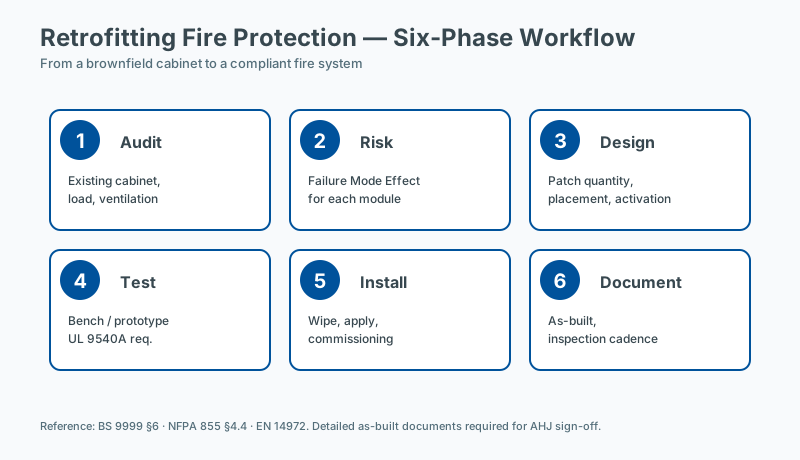 Retrofitting six-phase workflow
The overwhelming majority of electrical and electronic equipment currently in service was designed, manufactured, and installed without integrated fire suppression. Across industrial plants, commercial buildings, data centers, telecommunications huts, and transportation assets, switchgear, control panels, battery cabinets, server racks, and motor control centers have been deployed on the implicit assumption that a fire event is either extremely unlikely or will be addressed by the room-level sprinkler or gas system surrounding them. That assumption is no longer adequate.
Three converging pressures are forcing operators to retrofit fire protection directly into enclosures and equipment that were never built for it:
- Insurance carriers are tightening requirements after a string of high-profile losses, particularly involving lithium-ion battery storage, photovoltaic DC equipment, and aging switchgear.
- Regulatory bodies have updated codes — most notably the 2023 and 2026 revisions of NFPA 855 (energy storage), NFPA 76 (telecommunications), and EN 50600-2-4 (data centers) — to demand localized fire detection and suppression inside enclosures, not just at the room level.
- Operational experience has demonstrated that a single arc-flash or thermal-runaway event can destroy equipment worth hundreds of thousands of dollars, take critical processes offline for weeks, and in some cases result in regulatory non-compliance that prevents restart.
Retrofitting is fundamentally different from designing a new installation. The equipment is already in service, often under live conditions, and the modifier must work around existing wiring, bonding, grounding, and listing. This article walks through the standards that govern those modifications, the engineering process for evaluating and executing a retrofit, and the business criteria that determine when the investment is justified.
Why Retrofitting Is a Distinct Discipline
New-equipment fire protection is built into the specification: suppression cylinders are sized during the design phase, detection loops are integrated with the control architecture, and the entire system is type-tested and listed as a unit. Retrofitting, by contrast, is constrained by what already exists. The cabinet cannot be enlarged. The ventilation path cannot be redesigned. The electrical listing must not be voided. The installation must often occur with the equipment still energized, or at most during a short planned outage.
These constraints have driven the development of a category of products and practices often described as non-invasive, passive, or in-enclosure fire suppression. Their common characteristic is that they deliver fire-suppressant action inside an enclosure without piping, drilling, wiring into the control circuit, or altering the equipment’s electrical certification. The most widely deployed example is the self-adhesive conditioned-polymer patch, but the same engineering philosophy applies to linear heat-detection cable, optical flame detectors mounted on enclosure exteriors, and small clean-agent cylinders with thermal-only actuation.
Standards Governing Retrofit Work
Retrofit projects sit at the intersection of several standards regimes. None of them is dedicated exclusively to retrofitting, which is why the discipline is often misunderstood. The principal documents an engineer or facility manager must consult are summarized below, with notes on their specific relevance to in-enclosure retrofits.
| Standard | Issuing Body | Relevance to Retrofit Work |
|---|---|---|
| NFPA 70 (NEC) | NFPA | Electrical installation requirements; any modification must preserve code compliance, including working clearances, bonding, and conductor ampacity. |
| NFPA 72 | NFPA | Fire alarm and signaling code; integration with the existing building fire alarm must use listed initiating devices and compatible signal protocols. |
| NFPA 2001 | NFPA | Clean agent fire extinguishing systems; governs design concentration, hold time, and personnel safety for total-flooding systems. Applies to retrofit cylinders but not to localized passive patches, which are not total-flooding devices. |
| NFPA 855 | NFPA | Standard for the installation of stationary energy storage systems; 2023 edition added explicit requirements for in-cabinet detection and suppression at the module, rack, and unit level. |
| NFPA 76 | NFPA | Standard for the fire protection of telecommunications facilities; mandates localized fire suppression within equipment frames. |
| UL 508A | UL | Industrial control panels; any modification that affects the panel’s construction can compromise the UL listing, unless performed under a documented panel-building procedure. |
| UL 864 | UL | Control units and accessories for fire alarm systems; required for any detection device connected to a listed fire-alarm panel. |
| IEC 61439 | IEC | Low-voltage switchgear and controlgear assemblies; design verification must be repeated after modification, per Clause 10. |
| EN 50600-2-4 | CENELEC | Data centre infrastructure, part 2-4: telecommunications cabling infrastructure. Used in conjunction with EN 50600-2-5 for physical security and EN 50600-3-1 for management and operations; together they form the European framework that demands in-rack detection and suppression. |
| EN 50173 / ISO/IEC 11801 | CENELEC / ISO | Cabling standards; relevant when retrofitting involves adding Class A or Class B sensing circuits through existing cable pathways. |
| FM Global DS 5-33 | FM Global | Electrical testing and maintenance of electrical equipment; insurance-driven requirements that increasingly reference in-enclosure suppression. |
| IEC 62619 | IEC | Secondary lithium-ion cells for industrial applications; supports risk-based retrofit decisions for BESS installations. |
The key engineering insight is that most retrofit products are intentionally designed to fall outside the scope of NFPA 2001 because they do not perform total flooding. Instead, they are evaluated against component-level standards such as UL 711 (classification of fire-extinguishing agents) and have their suppressant performance validated through the manufacturer’s fire-test protocols. Engineers should request and review the underlying test data, not assume that the absence of a system-level listing indicates a deficiency.
The Retrofit Process: From Survey to Documentation
A defensible retrofit follows a sequence that closely mirrors a formal risk assessment. Skipping steps — particularly the site survey and the documentation phase — is the single most common cause of retrofits that look installed but do not survive an insurance audit or a regulatory inspection.
1. Site Survey and Inventory
The first deliverable is a complete inventory of enclosed electrical equipment: switchgear lineups, motor control centers, UPS cabinets, battery racks, rectifier shelves, network cabinets, control panels, and any other asset with an enclosure volume large enough to sustain a fire. For each item, the survey must record:
- External dimensions and approximate internal free volume.
- Ventilation openings, cable entries, and seams that affect pressure equalization.
- Existing detection and suppression, if any.
- Operating voltage, available fault current, and arc-flash incident energy.
- Adjacent assets and the fire propagation path between them.
- Ambient temperature range and presence of HVAC airflow.
- Whether the enclosure is UL-listed, CE-marked, or third-party certified.
2. Risk Prioritization
Not every enclosure is worth retrofitting. A defensible prioritization ranks each piece of equipment by the product of fire probability and consequence. Probability is informed by age, loading, maintenance history, and the presence of known ignition sources (loose terminations, overloaded busbars, lithium cells, hot components). Consequence is informed by replacement cost, downtime cost, criticality to operations, and safety risk to personnel.
A common heuristic used by facility managers is to act first on any equipment where the expected loss — replacement cost plus one year of downtime cost — exceeds one hundred times the cost of a passive suppression retrofit.
3. Product Selection and Sizing
The product selected must be matched to the enclosure’s internal free volume, the expected fire class (A, B, C, or combinations including lithium-ion), and any constraints imposed by the equipment listing. For self-adhesive passive patches, manufacturers typically publish volume-coverage tables that are validated against standardized fire-test protocols; the patch count and placement pattern should follow those tables without extrapolation.
For active retrofits — such as small clean-agent cylinders actuated by linear heat-detection cable — the design must satisfy NFPA 2001 design concentration requirements inside the enclosure and must account for leakage through seams and cable penetrations.
4. Installation
The defining advantage of non-invasive retrofits is that installation can occur while the equipment remains in service, often without a planned outage. The canonical installation sequence for a self-adhesive patch is:
- De-energize the specific sub-compartment if required by the equipment manufacturer’s safety procedures.
- Clean the interior mounting surface with isopropyl alcohol or an equivalent non-residue solvent.
- Allow the surface to dry completely.
- Peel the protective backing from the patch.
- Press the patch firmly onto the prepared surface for a minimum of 30 seconds.
- Verify adhesion and record the location on the as-built drawing.
Active retrofits require additional steps: mounting the cylinder, routing the linear detection cable, connecting the actuator, and verifying the interface with the fire-alarm panel.
5. Documentation and Verification
Documentation is the step that converts a physical installation into a defensible compliance record. The retrofit file should contain:
- The original equipment manufacturer and model.
- Pre-installation photographs.
- The risk assessment that justified the retrofit.
- The product data sheet and test certificates.
- The installation location, date, and installer signature.
- The post-installation photographs.
- Any updates to the single-line diagram, the fire-alarm matrix, and the emergency response plan.
Because passive patches do not modify the electrical system, they generally do not require re-listing of the host equipment under UL 508A or IEC 61439, provided the installer can demonstrate that no drilling, conductor addition, or change to creepage distances has occurred. This is one of the principal reasons the non-invasive approach has displaced older drilled-and-piped retrofit methods for many applications.
When Retrofitting Makes Business Sense
The decision to retrofit is ultimately an economic one, and the strongest cases share several characteristics:
- High equipment value or high downtime cost. Replacement of a medium-voltage switchgear lineup can exceed one million dollars, and the downtime cost for a process plant can reach tens of thousands of dollars per hour. Even modest fire prevention reduces expected loss dramatically.
- Remote or unmanned sites. Substations, telecommunications shelters, and pipeline valve sites cannot rely on a fire brigade within the response-time window required to prevent total loss.
- Insurance pressure. Many insurers now offer premium reductions or deductible waivers for documented in-enclosure suppression, and in some cases refuse to insure certain equipment classes without it.
- Contractual or regulatory mandates. Customer SLAs, government regulations, and industry-specific codes increasingly require localized fire protection within enclosures.
- Post-incident response. A near-miss or an industry-wide incident (such as a major battery-storage fire) often triggers a board-level decision to retrofit similar equipment across a fleet.
When three or more of these criteria apply to a given asset, the retrofit almost always has a positive net present value.
Engineering Considerations and Common Pitfalls
Retrofit projects fail most often for reasons unrelated to the suppression product itself:
- Ignoring the ventilation path. Enclosures with forced-air cooling can dilute a localized suppressant below its effective concentration. Patches and cylinders must be located on the downstream side of fans, not upstream.
- Mixing chemistries. Halogenated agents and certain dry chemicals can leave corrosive residues that damage electronics. For IT and telecommunications enclosures, conditioned-polymer or inert-gas products are usually preferred.
- Assuming one product fits all hazards. A patch designed for a Class C switchgear fire may not be effective on a lithium-ion thermal-runaway event, which requires suppression that addresses both the flame and the propagating cell-to-cell reaction.
- Skipping the documentation step. An undocumented retrofit is, in the eyes of an insurance adjuster or a regulatory inspector, no retrofit at all.
- Modifying a listed panel. Drilling an enclosure to mount a cylinder can void a UL 508A or IEC 61439 listing, with significant consequences for compliance and warranty.
Frequently Asked Questions
How often are fire safety standards updated?
Major fire safety standards are typically revised on a three- to five-year cycle, though some documents (NFPA 72 in particular) issue updates more frequently. New editions reflect incident learning, new technologies, and harmonization with related documents. Always check the edition cited in your project specification and verify whether a more recent edition has been adopted locally, as a standard cited by name without an edition is ambiguous.
What is the difference between a prescriptive and performance-based approach?
A prescriptive approach specifies the materials, dimensions, and configurations that must be used, for example a particular fire-resistance rating for a barrier. A performance-based approach defines the desired outcome (such as containment of the event within the enclosure for 60 minutes) and allows the designer to select the means, subject to engineering analysis and AHJ acceptance. Both are recognized by most modern fire codes, and the two are often combined within a single project.
Who enforces fire protection standards in practice?
Enforcement is the responsibility of the Authority Having Jurisdiction, typically a fire marshal, building department, or other local authority. In industrial settings, insurers and corporate EHS teams also enforce standards through contractual and audit requirements. The designer is responsible for selecting standards appropriate to the hazard and documenting the basis; the AHJ or insurer is responsible for verifying that the design meets the applicable requirements.
Does compliance with one standard guarantee acceptance in all jurisdictions?
No. Standards provide a common technical baseline, but the Authority Having Jurisdiction (AHJ) makes the final acceptance decision in each installation. NFPA documents apply broadly in the United States, EN standards across Europe, and GB standards in China, with local amendments common. A device listed by a recognized third-party certification body is more readily accepted, but plan reviewers and inspectors retain discretion.